| |
- Catholicos
- Catholicoi are the heads of some of the Eastern Orthodox, Oriental Orthodox, and Eastern Rite Catholic sui iuris churches (notably the Armenian), roughly similar to a Patriarch (see above).
- Primate
- A primate is usually the bishop of the oldest church of a nation. Sometimes this carries jurisdiction over metropolitan bishops, but usually it is purely honorific. The primate of the Scottish Episcopal Church is chosen from among the diocesan bishops, and, while retaining diocesan responsibility, is called Primus.
- Presiding Bishop or President Bishop
- These titles are often used for the head of a national Anglican church, but the title is not usually associated with a particular episcopal see like the title of a primate.
- Major archbishop
- Major archbishops are the heads of some of the Eastern Catholic Churches. Their authority within their sui juris church is equal to that of a patriarch, but they receive fewer ceremonial honors.
- Metropolitan bishop
- A metropolitan bishop is an archbishop in charge of an ecclesiastical province, or group of dioceses, and in addition to having immediate jurisdiction over his own archdiocese, also exercises some oversight over the other dioceses within that province. Sometimes a metropolitan may also be the head of an autocephalous, sui iuris, or autonomous church when the number of adherents of that tradition are small. In the Latin Rite, metropolitans are always archbishops; in many Eastern churches, the title is "metropolitan," with some of these churches using "archbishop" as a separate office.
- Archbishop
- An archbishop is the bishop of an archdiocese. This is usually a prestigious diocese with an important place in local church history. In the Roman Catholic Church, the title is purely honorific and carries no extra jurisdiction, though most archbishops are also metropolitan bishops, as above. In most provinces of the Anglican Communion, however, an archbishop has metropolitical and primatial power.
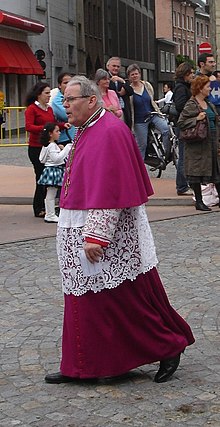
Monseigneur Roger Joseph Vangheluwe, Belgium
- Suffragan bishop
- A suffragan bishop is a bishop subordinate to a Metropolitan. In the Roman Catholic Church this term is applied to all non-metropolitan bishops (that is, diocesan bishops of dioceses within a metropolitan's province, and auxiliary bishops). In the Anglican Communion, the term applies to a bishop who is a full-time assistant to a diocesan bishop: the Bishop of Warwick is suffragan to the Bishop of Coventry (the diocesan), though both live in Coventry. Some Anglican suffragans are given the responsibility for a geographical area within the diocese (for example, the Bishop of Stepney is an area bishop within the Diocese of London).
- Titular bishop
- A titular bishop is a bishop without a diocese. Rather, the bishop is head of a titular see, which is usually an ancient city that used to have a bishop, but, for some reason or other, does not have one now. Titular bishops often serve as auxiliary bishops. In the Ecumenical Patriarchate, bishops of modern dioceses are often given a titular see alongside their modern one (for example, the Archbishop of Thyateira and Great Britain).
- Auxiliary bishop
- An auxiliary bishop is a full-time assistant to a diocesan bishop (the Catholic equivalent of an Anglican suffragan bishop). An auxiliary bishop is a titular bishop, and he is to be appointed as a vicar general or at least as an episcopal vicar of the diocese in which he serves.[11]
- Coadjutor bishop
- A coadjutor bishop is an auxiliary bishop who is given almost equal authority in a diocese with the diocesan bishop, and the automatic right to succeed the incumbent diocesan bishop. The appointment of coadjutors is often seen as a means of providing for continuity of church leadership.
- Honorary Assistant bishop or Bishop Emeritus
- The little is usually applied to retired bishops who are given a general licence to minister as episcopal pastors under a diocesan's oversight. The title, in this meaning, is not used by the Catholic Church.
- Chorbishop
- A chorbishop is an official of a diocese in some Eastern Christian churches. Chorbishops are not generally ordained bishops – they are not given the sacrament of Holy Orders in that degree – but function as assistants to the diocesan bishop with certain honorary privileges.
- Cardinal
- A cardinal is a member of the clergy appointed by the pope to serve in the College of Cardinals, the body empowered to elect the pope; however, on turning 80 a cardinal loses this right of election. Cardinals also serve as advisors to the pope and hold positions of authority within the structure of the Catholic Church. Under modern canon law, a man who is appointed a cardinal must accept ordination as a bishop, unless he already is one, or seek special permission from the pope to decline such ordination. Most cardinals are already bishops at the time of their appointment, the majority being archbishops of important archdioceses or patriarchs, and a substantial portion of the rest already titular archbishops serving in the Vatican. Recent popes have appointed a few priests, most of them influential theologians, to the College of Cardinals without requiring them to be ordained as bishops; invariably, these men are over the age of 80, which means they are not permitted to take part in a conclave. The purpose of these appointments is to recognise their tremendous contribution to the life of the Church.
[edit] Duties
In Catholicism, Eastern Orthodoxy, Oriental Orthodoxy, Lutheranism, and Anglicanism only a bishop can ordain other bishops, priests, and deacons.
In the Eastern liturgical tradition, a priest can celebrate the Divine Liturgy only with the blessing of a bishop. In Byzantine usage, an antimension signed by the bishop is kept on the altar partly as a reminder of whose altar it is and under whose omophorion the priest at a local parish is serving. In Syriac Church usage, a consecrated wooden block called a thabilitho is kept for the same reasons.
The pope, in addition to being the Bishop of Rome and spiritual head of the Catholic Church, is also the Patriarch of the Latin Rite. Each bishop within the Latin Rite is answerable directly to the Pope and not any other bishop except to metropolitans in certain oversight instances. The pope previously used the title Patriarch of the West, but this title was dropped from use in 2006[12] a move which caused some concern within the Orthodox Communion as, to them, it implied wider papal jurisdiction.[13]
In Catholic, Eastern Orthodox, Oriental Orthodox and Anglican cathedrals there is a special chair set aside for the exclusive use of the bishop. This is the bishop's cathedra and is often called the throne. In some Christian denominations e.g. the Anglican Communion, parish churches may maintain a chair for the use of the bishop when he visits; this is to signify the parish's union with the bishop.
The bishop is also the proper minister of the sacrament of confirmation, and in the Anglican Communion and Liberal Catholic communion only a bishop may administer this sacrament. However, in Eastern Orthodox and Oriental Orthodox churches chrismation is always done at the same time as baptism, and thus the priest is the one who confirms. Within Catholicism, it is invariably the bishop who confirms those being received as adults into the Church. Also, a Catholic bishop may delegate a priest to administer the sacrament in his place; these men are called episcopal vicars and are usually responsible for a particular area of the diocese.
[edit] Ordination of Catholic, Orthodox and Anglican Bishops

The now-deceased Patriarch Alexius II of Moscow and All Russia consecrating a Russian Orthodox diocesan bishop. Ordination of a bishop, and thus continuation of apostolic succession, takes place through a ritual centred on the imposition of hands and prayer.
Bishops in all of these communions are ordained by other bishops through the laying on of hands. While traditional teaching maintains that any bishop with Apostolic succession can validly perform the ordination of another bishop, some churches require two or three bishops participate, either to insure sacramental validity or to conform with church law. Roman Catholic doctrine holds that one bishop can validly ordain another male (priest) as a bishop. Though a minimum of three bishops participating is desirable (there are usually several more) in order to demonstrate collegiality, canonically only one bishop is necessary. The practice of only one bishop ordaining was normal in countries where the Church was persecuted under Communist rule.
Apart from the ordination, which is always done by other bishops, there are different methods as to the actual selection of a candidate for ordination as bishop. In the Catholic Church the Congregation for Bishops oversees the selection of new bishops with the approval of the pope. The papal nuncio usually solicits names from the bishops of a country, and then selects three to be forwarded to the Holy See. Most Eastern Orthodox churches allow varying amounts of formalised laity and/or lower clergy influence on the choice of bishops. This also applies in those Eastern churches which are in union with the pope, though he is required to give assent.
Catholic, Orthodox, Anglican, Liberal Catholic and some Lutheran bishops (e.g. Sweden) claim to be part of the continuous sequence of ordained bishops since the days of the apostles referred to as Apostolic succession. Since Pope Leo XIII issued the bull Apostolicae Curae in 1896, the Catholic Church has insisted that Anglican orders are invalid because of changes in the Anglican ordination rites of the 16th century and divergence in understanding of the theology of priesthood, episcopacy and Eucharist. However, since the 1930s, Utrecht Old Catholic bishops (recognised by the Holy See as validily ordained) have sometimes taken part in the ordination of Anglican bishops. According to the writer Timothy Dufort, by 1969, all Church of England bishops had acquired Old Catholic lines of apostolic succession recognised by the Holy See.[14] This development has muddied the waters somewhat as it could be argued that the strain of Apostolic Succession has been re-introduced into Anglicanism, at least within the Church of England.
The Catholic Church does recognise as valid (though illicit) ordinations done by breakaway Catholic, Old Catholic or Oriental bishops, and groups descended from them; it also regards as both valid and licit those ordinations done by bishops of the Eastern churches,[15] so long as those receiving the ordination conform to other canonical requirements (e.g. is an adult male) and an orthodox rite of episcopal ordination, expressing the proper functions and sacramental status of a bishop, is used; this has given rise to the phenomenon of episcopi vagantes (e.g. clergy of the Independent Catholic groups which claim Apostolic Succession, though this claim is rejected by both Orthodoxy and Catholicism).
The Orthodox Churches would not accept the validity of any ordinations performed by the Independent Catholic groups, as Orthodoxy considers to be spurious any consecration outside of the Church as a whole. Orthodoxy considers Apostolic succession to exist only within the Universal Church, and not through any authority held by individual bishops; thus, if a bishop ordains someone to serve outside of the (Orthodox) Church, the ceremony is ineffectual, and no ordination has taken place regardless of the ritual used or the ordaining prelate's position within the Orthodox Churches.

The consecrated bishop is the only minister of Holy Orders. Photo of pre-Vatican II ceremony
The position of Roman Catholicism is slightly different. Whilst it does recognise the validity of the orders of certain groups which separated from communion with Holy See. The Holy See accepts as valid the ordinations of the Old Catholics in communion with Utrecht, as well as the Polish National Catholic Church (which received its orders directly from Utrecht, and was—until recently—part of that communion); but Roman Catholicism does not recognise the orders of any group whose teaching is at variance with core tenets of Christianity e.g. The Liberal Catholic Church which has a strong theosophist tendency and permits belief in reincarnation; this is the case even though the clergy of the Independent Catholic groups may use the proper ordination ritual. There are other reasons why the Holy See does not recognise the validity of the orders of the Independent clergy: (a) the continuing practice among many Independent clergy of one person receiving multiple ordinations in order to secure apostolic succession, betrays an incorrect and mechanistic theology of ordination as far as the Holy See is concerned (b) the practice within Independent groups of ordaining women demonstrates an understanding of Priesthood which is totally unacceptable to the Catholic and Orthodox churches as they believe that the Universal Church does not possess such authority; thus, any ceremonies performed by these women are considered to be sacramentally invalid. (c) the theology of male clergy within the Independent movement is also suspect according to the Roman Catholics as they presumably approve of the ordination of females, and may have even undergone an (invalid) ordination ceremony conducted by a woman.
Whilst members of the Independent Catholic movement take seriously the issue of valid orders, it is highly significant that the relevant Vatican Congregations tend not to respond to petitions from Independent Catholic bishops and clergy who seek to be received into communion with the Holy See, hoping to continue in some sacramental role. In those instances where the pope does grant reconciliation, those deemed to be clerics within the Independent Old Catholic movement are invariably admitted as laity and not priests or bishops.
There is a mutual recognition of the validity of orders amongst Roman Catholic, Eastern Orthodox, Old Catholic, Oriental Orthodox and Assyrian Nestorian churches.
Some provinces of the Anglican Communion have begun ordaining women as bishops in recent decades e.g. the United States, New Zealand, Canada and Cuba. The first woman bishop within Anglicanism was Barbara Clementine Harris, who was ordained in the United States in 1989. In 2006, Katharine Jefferts Schori, the Episcopal Bishop of Nevada, became the first woman to become the Presiding Bishop of the Episcopal Church.
[edit] Lutheranism
In the Evangelical Lutheran Church in America (ELCA) and the Evangelical Lutheran Church in Canada (ELCIC), the largest Lutheran Church bodies in North America and roughly based on the Nordic Lutheran state churches (similar to that of the Church of England), bishops are elected by Synod Assemblies, consisting of both lay members and clergy, for a term of 6 years, which can be renewed, depending upon the local synod's "constitution" (which is mirrored on either the ELCA or ELCIC's national constitution). Since the implementation of concordats between the ELCA and the Episcopal Church of the United States and the ELCIC and the Anglican Church of Canada, all bishops, including the Presiding Bishop (ELCA) or the National Bishop (ELCIC), has been consecrated using the historic succession, with at least one Anglican bishop serving as co-consecrator.[16][17]
Since going into ecumenical communion with their respective Anglican body, bishops in the ELCA or the ELCIC not only approve the "rostering" of all ordained pastors, diaconal ministers, and associates in ministry, but they serve as the principle celebrant of all pastoral ordination and installation ceremonies, diaconal consecration ceremonies, as well as serving as the "chief pastor" of the local synod, upholding the teachings of Martin Luther as well as the documentations of the Ninety-Five Thesis and the Augsburg Confession. Unlike their counterparts in the United Methodist Church, ELCA and ELCIC synod bishops do not appoint pastors to local congregations (pastors, like their counterparts in the Episcopal Church, are called by local congregations), and are not "bishops for life," they revert to the title "Pastor" after completing their episcopal service. The Presiding Bishop of the ELCA and the National Bishop of the ELCIC, the national bishops of their respective bodies, is elected for a single 6-year term and may be elected to an additional term.
It should be noted that although ELCA agreed with the Episcopal Church to limit ordination to the bishop "ordinarily", ELCA pastor-ordinators are given permission to perform the rites in "extraordinary" circumstance. In practice, "extraordinary" circumstance have included disagreeing with Episcopalian views of the episcopate, and as a result, ELCA pastors ordained by other pastors are not permitted to be deployed to Episcopal Churches (they can, however, serve in Presbyterian Church USA, Reformed Church in America, and Moravian Church congregations, as the ELCA is in full communion with these denominations). The Lutheran Church–Missouri Synod (LCMS) and the Wisconsin Evangelical Lutheran Synod (WELS), the second and third largest Lutheran bodies in the United States and the two largest Confessional Lutheran bodies in North America, do not have a bishop as the head of the church or middle jurisdiction, practicing a form of congregationalism similar to the United Church of Christ. It should also be noted that the second largest of the three predecessor bodies of the ELCA, the American Lutheran Church, was a congregationalist body, with national and synod presidents before they were re-titled as bishops (borrowing from the Lutheran churches in Germany) in the 1980s.
[edit] Methodism
[edit] United Methodist Church

United Methodist Episcopal Shield
In the United Methodist Church (the largest branch of Methodism) bishops serve as administrative and pastoral superintendents of the church. They are elected for life from among the ordained elders (presbyters) by vote of the delegates in regional (called jurisdictional) conferences, and are consecrated by the other bishops present at the conference through the laying on of hands. In the United Methodist Church bishops remain members of the "Order of Elders" while being consecrated to the "Office of the Episcopacy." Within the United Methodist Church only bishops are empowered to consecrate bishops and ordain clergy. Among their most critical duties is the ordination and appointment of clergy to serve local churches as pastor, presiding at sessions of the Annual, Jurisdictional, and General Conferences, providing pastoral ministry for the clergy under their charge, and safeguarding the doctrine and discipline of the Church. Furthermore, individual bishops, or the Council of Bishops as a whole, often serve a prophetic role, making statements on important social issues and setting forth a vision for the denomination, though they have no legislative authority of their own. In all of these areas, bishops of the United Methodist Church function very much in the historic meaning of the term. According to the Book of Discipline of the United Methodist Church, a bishop's responsibilities are
Leadership.—Spiritual and Temporal.—
- To lead and oversee the spiritual and temporal affairs of The United Methodist Church, which confesses Jesus Christ as Lord and Savior, and particularly to lead the Church in its mission of witness and service in the world.
- To travel through the connection at large as the Council of Bishops (¶ 526) to implement stategy for the concern of the Church.
- To provide liaison and leadership in the quest for Christian unity in ministry, mission, and structure and in the search for strengthened relationships with other living faith communities.
- To organize such Missions as shall have been authorized by the General Conference.
- To promote and support the evangelistic vision of the whole Church.
- To discharge such other duties as the Discipline may direct.
Presidential Duties.—1. To preside in the General, Jurisdictional, Central, and Annual Conferences. 2. To form the districts after consultation with the district superintendents and after the number of the same has been determined by vote of the Annual Conference. 3. To appoint the district superintendents annually (¶¶ 517–518). 4. To consecrate bishops, to ordain elders and deacons, to consecrate diaconal ministers, to commission deaconesses and home missionaries, and to see that the names of the persons commissioned and consecrated are entered on the journals of the conference and that proper credentials are funised to these persons.
Working with Ministers.—1. To make and fix the appointments in the Annual Conferences, Provisional Annual Conferences, and Missions as the Discipline may direct (¶¶ 529–533). 2. To divide or to unite a circuit(s), stations(s), or mission(s) as judged necessary for missionary strategy and then to make appropriate appointments. 3. To read the appointments of deaconesses, diaconal ministers, lay persons in service under the World Division of the General Board of Global Ministries, and home missionaries. 4. To fix the Charge Conference membership of all ordained ministers appointed to ministries other than the local church in keeping with ¶443.3. 5. To transfer, upon the request of the receiving bishop, minsterial member(s) of one Annual Conference to another, provided said member(s) agrees to transfer; and to send immediately to the secretaries of both conferences involved , to the conference Boards of Ordained Ministry, and to the clearing house of the General Board of Pensions written notices of the transfer of members and of their standing in the course of study if they are undergraduates.[18]
In each Annual Conference, United Methodist bishops serve for four year terms, and may serve up to three terms before either retirement or appointment to a new Conference. United Methodist bishops may be male or female, with the Rev. Marjorie Matthews being the first woman to be consecrated a bishop in 1980.
The collegial expression of episcopal leadership in the United Methodist Church is known as the Council of Bishops. The Council of Bishops speaks to the Church and through the Church into the world and gives leadership in the quest for Christian unity and interreligious relationships.[19] The Conference of Methodist Bishops includes the United Methodist Council of Bishops plus bishops from affiliated autonomous Methodist or United Churches.

Asbury's consecration as bishop in 1784.
John Wesley consecrated Thomas Coke a "General Superintendent," and directed that Francis Asbury also be consecrated for the United States of America in 1784, where the Methodist Episcopal Church first became a separate denomination apart from the Church of England. Coke soon returned to England, but Asbury was the primary builder of the new church. At first he did not call himself bishop, but eventually submitted to the usage by the denomination.
Notable bishops in United Methodist history include Coke, Asbury, Richard Whatcoat, Philip William Otterbein, Martin Boehm, Jacob Albright, John Seybert, Matthew Simpson, John S. Stamm, William Ragsdale Cannon, Marjorie Matthews, Leontine T. Kelly , William B. Oden, Ntambo Nkulu Ntanda, Joseph Sprague, William Henry Willimon, and Thomas Bickerton.
Methodists in the United Kingdom acquired their own bishops early in the nineteenth century, after the Methodist movement in Britain formally parted company with the Church of England. The position no longer exists in British Methodism.
[edit] Christian Methodist Episcopal Church
In the Christian Methodist Episcopal Church, bishops are administrative superintendents of the church; they are elected by "delegate" votes for as many years deemed until the age of 74, then he/she must retire. Among their duties, are responsibility for appointing clergy to serve local churches as pastor, for performing ordinations, and for safeguarding the doctrine and discipline of the Church. The General Conference, a meeting every four years, has an equal number of clergy and lay delegates. In each Annual Conference, CME bishops serve for four year terms. CME Church bishops may be male or female.
[edit] The Church of Jesus Christ of Latter-day Saints
In The Church of Jesus Christ of Latter-day Saints, the Bishop is the leader of a local congregation, called a ward. As with most Mormon priesthood, the Bishop is a part-time lay minister and earns a living through other employment; in all cases, he is a married man. As such, it is his duty to preside at services, call local leaders, and judge the worthiness of members for service. The bishop does not deliver sermons at every service (generally asking members to do so), but is expected to be a spiritual guide for his congregation. It is therefore believed that he has both the right and ability to receive divine inspiration (through the Holy Spirit) for the ward under his direction. Because it is a part-time position, all able members are expected to assist in the management of the ward by holding delegated lay positions (e.g. women's' and youth leaders, teachers) referred to as callings. Although members are asked to confess serious sins to him, unlike the Roman Catholic Church, he is not the instrument of divine forgiveness, merely a guide through the repentance process (and a judge in case transgressions warrant excommunication or other official discipline). The bishop is also responsible for the physical welfare of the ward, and thus collects tithing and fast offerings and distributes financial assistance where needed.
A bishop is the president of the Aaronic priesthood in his ward (and is thus a form of Mormon Kohen; in fact, the church's Doctrine and Covenants states that any "descendant of Aaron" who converts to Mormonism has no need to be ordained to the office of bishop as they descend from that lineage directly). A bishop is also a High priest in the Melchizedek priesthood. Each bishop is selected from resident members of the ward by the stake presidency with approval of the First Presidency, and chooses two counselors to form a bishopric. In special circumstances (such as a ward consisting entirely of young university students), a bishop may be chosen from outside the ward. A bishop is typically released after about five years and a new bishop is called to the position. Although the former bishop is released from his duties, he continues to hold the priesthood office of bishop, and is usually still referred to by the title "Bishop" as a term of respect.
Latter Day Saint bishops do not wear any special clothing or insignia the way clergy in many other churches do, but are expected to dress and groom themselves neatly and conservatively per their local culture, especially when performing official duties. Bishops (as well as other members of the priesthood) can trace their line of authority back to Joseph Smith, Jr., who, according to church doctrine, was ordained to lead the Church in modern times by the ancient apostles Peter, James, and John, who were ordained to lead the Church by Jesus Christ.
The Presiding Bishop oversees the temporal affairs (buildings, properties, commercial corporations, etc.) of the worldwide Church, including the Church's massive global humanitarian aid and social welfare programs. The Presiding Bishop has two counselors; the three together form the Presiding Bishopric.
[edit] New Apostolic Church
The New Apostolic Church (NAC) knows 3 classes of ministries: Deacons, Priests and Apostles. The Apostles, who are all included in the apostolate with the Chief Apostle as head, are the highest ministries.
Of the several kinds of priest-ministries, the bishop is the highest. Nearly all bishops are set in line directly from the chief apostle. They support and help their superior apostle.
[edit] Church of God (Cleveland, Tennessee)
In the polity of the Church of God (Cleveland, Tennessee), the international leader is the Presiding Bishop, and the members of the Executive Committee are Executive Bishops. Collectively, they supervise and appoint national and state leaders across the world. Leaders of individual states and regions are Administrative Bishops, who have jurisdiction over local churches in their respective states and are vested with appointment authority for local pastorates. All ministers are credentialed at one of three levels of licensure, the most senior of which is the rank of Ordained Bishop. To be eligible to serve in state, national, or international positions of authority, a minister must hold the rank of Ordained Bishop.
[edit] Pentecostal Church of God
In 2002, the general convention of the Pentecostal Church of God came to a consensus to change the title of their overseer from General Superintendent to Bishop. The change was brought on because internationally, the term Bishop is more commonly related to religious leaders than the previous title.
The title Bishop is used for both the General (International leader) and the district (state) leaders. The title is sometimes used in conjunction with the previous thus becoming General (District) Superintendent/Bishop.
[edit] Others
Some Baptists have begun taking on the title of Bishop.[3]
In some smaller Protestant denominations and independent churches the term bishop is used in the same way as pastor, to refer to the leader of the local congregation, and may be male or female. This usage is especially common in African American churches in the USA. In the Church of Scotland, which has a Presbyterian church structure, the word "bishop" refers to an ordained person, usually a normal parish minister, who has temporary oversight of a trainee minister. In the Presbyterian Church (U.S.A.), the term bishop is an expressive name for a Minister of Word and Sacrament who serves a congregation and exercises "the oversight of the flock of Christ."[20] The term is traceable to the 1789 Form of Government of the PC(U.S.A.) and the Presbyterian understanding of the pastoral office.
While not Christian, Ecclesia Gnostica Catholica uses roles and titles derived from Christianity for its clerical hierarchy, including Bishops who have much the same authority and responsibilities as in Roman Catholicism.
The Salvation Army does not have bishops but have appointed leaders of geographical areas known as Divisional Commanders. Larger geographical areas, called Territories, are led by a Territorial Commander, who is the highest ranking officer in that Territory.
[edit] Dress and insignia
Traditionally, a number of items are associated with the office of a bishop, most notably the mitre, crosier, and ecclesiastical ring. Other vestments and insignia vary between Eastern and Western Christianity.
In the Latin branch of the Catholic Church, the choir dress of a bishop includes the purple cassock with amaranth trim, rochet, purple zucchetto (skull cap), purple biretta, and pectoral cross. The accoutrements of a bishop include the pontifical gloves and pontifical sandals, but these items are rarely seen today except within the context of the Extraordinary Form (the Tridentine Mass). The cappa magna, which was once used as choir dress for bishops on solemn occasions, is also rarely seen although its use is permitted. The coat of arms of a Latin Rite Catholic bishop will usually display a galero with a cross and crosier behind the escutcheon; however, the specifics will differ by location and ecclesiastical rank (see Ecclesiastical heraldry).
Anglican bishops generally make use of the mitre, crosier, ecclesiastical ring, purple cassock, purple zucchetto, and pectoral cross. However, the traditional choir dress of Anglican bishops is quite different from that of their Catholic counterparts; it consists of a long rochet which is worn with a chimere.
In the Eastern Churches (Eastern Orthodox, Eastern Rite Catholic) a bishop will wear the mandyas, panagia (and perhaps an enkolpion), sakkos, omophorion and an Eastern-style mitre. Eastern bishops do not normally wear an episcopal ring; the faithful will kiss the bishop's hand. To seal official documents, he will usually use an inked stamp. An Eastern bishop's coat of arms will normally display an Eastern-style mitre, cross, eastern style crosier and a red and white (or red and gold) mantle. The arms of Oriental Orthodox bishops will display the episcopal insignia (mitre or turban) specific to their own liturgical traditions. Variations will occur based upon jurisdiction and national customs.
[edit] See also
- , "bishop." Cross, F. L., ed. The Oxford Dictionary of the Christian Church. New York: Oxford University Press. 2005
- , Oxford Dictionary of the Christian Church, 1997 edition revised 2005, page 211: "It seems that at first the terms 'episcopos' and 'presbyter' were used interchangeably ..."
- , Cambridge History of Christianity, volume 1, 2006, "The general consensus among scholars has been that, at the turn of the first and second centuries, local congregations were led by bishops and presbyters whose offices were overlapping or indistinguishable."
- , a b c O'Grady, John. The Roman Catholic church: its origins and nature. p. 140.
- , O'Grady, John. The Roman Catholic church: its origins and nature. p. 146.
- , O'Grady, John. The Roman Catholic church: its origins and nature. pp. 17–18.
- , http://en.wikipedia.orghttp://en.wikipedia.org/wiki/Chorbishop
- , Clement, "Hom.", III, lxxii; cfr. Stromata, VI, xiii, cvi; cf. "Const. Apost.", II, viii, 36
- , "Didascalia Syr.", IV; III, 10, 11, 20; Cornelius, "Ad Fabianum" in Eusebius, Historia Ecclesiastica, VI, xliii.
- , Bernard Botte, O.S.B., La Tradition apostolique de saint Hippolyte: Essai de reconstitution, LQF 39 (Munster-Westfalen, 1963). English Translation added at website.
- , "Canon 406". Code of Canon Law. The Holy See. 1983. http://www.vatican.va/archive/ENG1104/__P1F.HTM. Retrieved 2009-06-15.
- , Catholic News Service 2nd March 2006
- , CNS 13 June 2006
- , Timothy Dufort, The Tablet, May 29, 1982, pp. 536–538.
- , Unitatis Redintegratio 16: "To remove, then, all shadow of doubt, this holy Council solemnly declares that the Churches of the East, while remembering the necessary unity of the whole Church, have the power to govern themselves according to the disciplines proper to them, since these are better suited to the character of their faithful, and more for the good of their souls."
- , [1] "Called to Common Mission," 1999. viewed 29 September 2006
- , [2] Wright, J. Robert, "The Historic Episcopate: An Episcopalian Viewpoint," Lutheran Partners, March / April 1999—Volume 15, Number 2, viewed 29 September 2006
- , The Book of Discipline of the United Methodist Church: Specific Responsibilities of Bishops—¶ 514–516 (retrieved 27 May 2007).
- , The Book of Discipline of the United Methodist Church: Council of Bishops—¶ 526 (retrieved 27 May 2007).
- , Presbyterian Church (U.S.A.). Book of Order (2009-2011) (Louisville: Office of the General Assembly), G-6.0202.
[edit] References
- Ignatius of Antioch, Epistles of to the Ephesians, Magnesians, Trallesians, and Smyrnans, Lightfoot, trans., Harmer, ed. (Kessinger, 1891/2003). ISBN 0-7661-6498-5
- Mathews, James, Set Apart To Serve: The Role of the Episcopacy in the Wesleyan Tradition (Nashville: Abingdon, 1985).
- Moede, Gerald, The Office of Bishop in Methodism: Its History and Development (Nashville: Abingdon, 1965).
[edit] External links
(Source: Wikipedia) |
|